riverdale is good, actually
In a world of Russos, be an Aguirre-Sacasa.

You know what Riverdale is, but I’m telling you anyway. It’s a television adaptation of the Archie comics, created by my literary idol, Roberto Aguirre-Sacasa.
Riverdale begins with the death of golden boy Jason Blossom, in an act of violence that shocks the very normal town. Season 1 really wants you to know that everything is normal. The characters themselves are playing heightened versions of who they think they should be: Archie limiting himself to the hypermasculine ideal of The Jock, with that most all-American pastime of high school football; Betty repressing herself into the ideal of a Good Girl so hard that in order to express “unfeminine” emotions like anger and sexual desire, she has to channel them through the persona of Dark Betty. Veronica is trying to reinvent herself in a new town to get out of her father’s shadow and Cheryl is internalised homophobia-ing so gloriously that she gets Archie to beard for her.
We’ll get to Jughead. Don’t worry.
The first letter of every song in the Season 1 soundtrack literally spells out “RIVERDALE IS A NORMAL TOWN”. The murder of Jason Blossom is treated as this shocking event that fundamentally changed Riverdale. But it didn’t. The rot was already there.
Haters will see you teleport and be like “he can’t afford a car”. This is what most Riverdale-critical content is like also.
And listen, I get it. Queerbaiting bad, tokenism bad. The show wants credit for being diverse, but it doesn’t want to actually have depth about it. The first season only has one Black guy in it, and he’s the character who represents the concept of sexual harassment. The first season is not good. You get thirteen episodes of a passable murder mystery, and if you sit through that, you get the good stuff. The cults. The serial killers. The two different Bret Easton Ellis parody characters. Haha, do you get it? His name is Bret Weston-Wallis! And he has a token Black friend and a token Asian friend and they have no distinguishable personality traits and are both killed offscreen! To be fair, Bret Weston-Wallis was also killed offscreen, but that doesn’t count because I don’t think he’s really dead.
By the time Jughead skinned a woman and the Gargoyle King turned out to be the gay porn star who impersonated Betty’s half-brother in the third season, a lot of fans had already had it with the show’s shit. The dominant narrative is that Riverdale started off well, but, as CW shows are wont to do, decreased in quality over time due to the writers running out of places to go and thus doing more and more ridiculous things, which is how you get the Gargoyle King turning out to be the gay porn star who impersonated Betty’s half-brother. However, I would like to propose a different theory.
I do not believe that a show needs to be a subversive masterpiece to be good. I don’t believe a show needs to be good to be entertaining. But this is all a moot point, because Riverdale is all of those things.
There are about nine thousand YouTube videos with titles like Riverdale Cringe Part 69: I Think “Cringe” Is When A Latino DILF Speaks Spanish, and an equal number of lengthy Tumblr meta posts that say things like, “Betty is a bad person, which means the show is bad”, and it’s like yes, she’s an anti-hero, they address this like every three episodes, you have discovered the plot. The creators of these videos aren’t wrong for disliking the show—that’s a matter of opinion—but they are misrepresenting it, and I’d like to correct the record.
Riverdale Is Good, Actually. That’s my thesis here. Riverdale isn’t perfect, but it’s good. It’s fun and witty and surreal, like some kind of weird fa…
My personal favourite words penned about Riverdale are the title of Eric Thurm’s review of the episode “The Great Escape”. It reads as follows: “Riverdale stages a dramatic escape from coherence”. Brilliant, showstopping, spectacular. Camp, even.
And make no mistake, Riverdale is deliberate Camp. It is not a show that takes itself seriously, nor has it ever been. I’m not taking any of that “it started out normal and then it got weird” hogwash. Josie performs the song Cheryl claims she and Jason were conceived to at Jason’s memorial in the first episode. We all knew what we were getting into here. As Lindsay Ellis once said, your uninformed observation does not make you smarter than the media you consume; it just means you’re not paying attention.
But I was paying attention. And the ghost of Susan Sontag whispered in my ear, and this is what she told me.
1. To start very generally: Camp is a certain mode of aestheticism. It is one way of seeing the world as an aesthetic phenomenon. That way, the way of Camp, is not in terms of beauty, but in terms of the degree of artifice, of stylization [sic].
2. To emphasise style is to slight content, or to introduce an attitude which is neutral with respect to content. It goes without saying that the Camp sensibility is disengaged, depoliticized [sic] — or at least apolitical.
8. Camp is a vision of the world in terms of style — but a particular kind of style. It is the love of the exaggerated, the “off,” of things-being-what-they-are-not.
26. Camp is art that proposes itself seriously, but cannot be taken altogether seriously because it is “too much.”
41. The whole point of Camp is to dethrone the serious. Camp is playful, anti-serious. More precisely, Camp involves a new, more complex relation to “the serious.” One can be serious about the frivolous, frivolous about the serious.
— Susan Sontag, Notes on Camp
I think Riverdale is deliberate Camp in the way Sontag describes it in those quotes from before. The exaggerated, the “too much”, that which presents itself seriously but is really anti-serious. Sontag says that Camp is a woman wearing a dress made of a thousand feathers, and I say that Camp is when Jughead had never been seen without that stupid hat on. This essay is for Oscar Wilde.
I’m going to say something, and you’re gonna sit there and hear me out, because that’s how this medium works.
“The epic highs and lows of high school football” is a good line. It’s funny. It makes me laugh. It makes the cringe compilation makers laugh, they just have to do a cognitive dissonance about it where they pretend that laughing at a joke makes the joke bad.
I would talk about Archie’s Weird Fantasy, because I do think that understanding the story of Archie’s Weird Fantasy is integral to understanding Riverdale, but that really deserves its own thing, so, you know, like, comment and subscribe for that.
Instead, let’s have a look at my favourite episode from Season 3, “The Red Dahlia”. The plot is as follows.
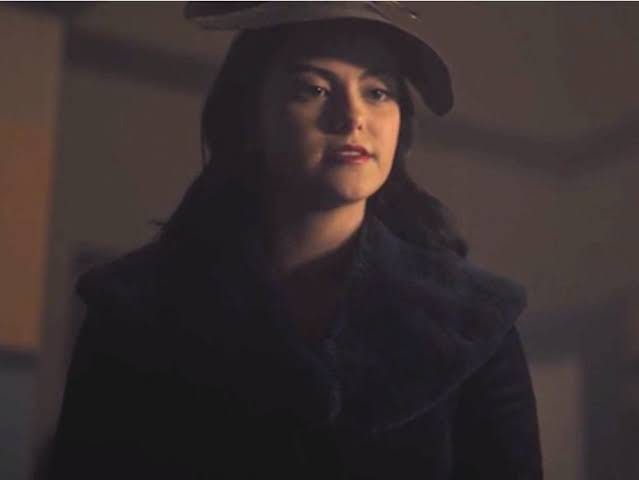
Veronica suspects that her mother shot her father and enlists Jughead to solve the mystery. Jughead’s way of doing this is to ask Veronica’s mother to her face if she did it. Meanwhile Betty goes to Cheryl’s uncle’s funeral to antagonise her and Veronica gets into mob drama.
Betty meets up with Jughead after she gets back from starting drama at a funeral so they can be even more annoying together. They go to a brothel and inconvenience a dominatrix until they happen upon Cheryl’s mum, who tells them a bunch of her backstory. Veronica does some more girlboss shit. Jughead breaks into a house to investigate water corruption after it is revealed that Veronica’s dad invented a fake virus to justify quarantining the town, because it was 2018 and everything was beautiful and nothing hurt.
Anyway, Jughead finds out that Veronica’s mum and her cop boyfriend did the deed. He’s about to tell Veronica this when she says the final line of the episode and also the best line of all time that I quote constantly: “Forget it Jughead, it’s Riverdale.”
This episode is Riverdale at its best. The writing spares no expense in making sure you know that Jughead is annoying and causing problems on purpose. Andrew Hussie once said that the upper echelons of irony always contain a trace of sincerity, and I do believe that in this episode Cole Sprouse is just recreating his Tumblr social experiment on a larger and more hilarious scale. Veronica is dressed in this over-the-top attempt at a classic Noir femme fatale (pictured above) and this is the episode where Camila Mendes most looks like a teenager. I am seeing a child wearing her mum’s high heels and pretending to be a grown-up. I am seeing a girl whose parents have failed to take care of her and so is acting in the role of the parent. Both characters are trying so hard to seem like adults, and even though they’re played by adults, it isn’t working, because the perspective that they’re coming from, the anxieties they express are so teenage. What if my parents get divorced? What if I turn out like my parents? How am I supposed to develop into an autonomous human being if most of my life is spent in situations where an adult has complete authority over me? People joke sometimes about how every plot point in Riverdale is treated like it’s the most important thing, whether it’s Veronica’s dad poisoning the town’s water supply or Jughead falling behind on his homework. Reader, you’ve probably been to high school. Tell me, isn’t that what it felt like?
Riverdale isn’t going for literal realism, rather tapping into a more emotional realism. In the same way that the stalking in Pretty Little Liars (another property greatly improved by RAS) resonates with the teenage feeling of constantly being watched and judged, the constant onslaught of insane drama in Riverdale rings emotionally true to the stage of adolescence when your parents mistakenly decide you’re old enough to learn the family secrets. The age when you find out what the world is like and it’s horrible.
Every character in Riverdale essentially lives in a different genre that is essential to American pop culture, and they all have to reconcile with the conventions of those genres. Let’s take Archie and Betty as our examples.
Archie lives in the world of action and war films, which are a blueprint for a vision of masculinity that isn’t working for him anymore. As the trauma piles up, he can’t channel the action-movie values of strength and bravery into sports anymore. He’s beating up petty criminals in order to “protect the children” but he ends up exposing those very children to more danger in the process. He joins the military because he feels he has no other options and ends up with PTSD from a mission he was sent on for his superior officer’s ego during a war whose purpose is never explained. His canon is one where strong men save the day, rescue the innocent and get the girl, but Archie’s constant fighting, while momentarily cathartic, leaves him sad, alone and hallucinating dead soldiers. This is why high school football is so important to Archie’s arc: it’s the only way he can take his desire for physical strength and dominance and turn it into something healthy, a cultural event that brings people together and saves the town from Hiram Lodge’s gentrification quest.
Betty lives in mystery and thriller movies, initially as a plucky girl detective à la Nancy Drew, but she can’t keep up the good girl act forever. She’s got the serial killer gene. She’s the ultimate wild card. The daughter of the Black Hood. The nightmare from next door. She’s training with the FBI, and she’s coming for you, you psycho bitch. Betty was raised by Alice Cooper, known in later seasons as Alice Smith after her parents divorce due to Hal being a serial killer. Alice is from the impoverished South Side of Riverdale and is a former gang member and pregnant teen turned journalist who shits out hitpiece after hitpiece against the gang that raised her in order to retain her status in the upper middle class North Side. Alice’s need to hold on to her status as the perfect WASP woman gets projected onto Betty, who is put under this immense pressure to be the all-American girl next door, and later the perfect FBI agent. The trouble is that Betty likes violence, and being an FBI agent gives her a socially acceptable outlet for this. Basically, ACAB: All Cops Are Betty.
And then there’s Jughead. I told you we’d get to Jughead. Jughead is a Guy Who Likes Movies. He’s the narrator, the framing device for our story, who switches seamlessly between genres depending on who he’s interacting with. You can see this very subtly—“subtly” by Riverdale standards—in The Red Dahlia; in his scenes with Veronica, who lives squarely in the crime genre, he’s doing Chinatown, but in his scenes with Betty, he’s doing Sherlock. If Riverdale is a painting, Jughead is the frame. He’s at the centre of everything, and at the same time on the outside looking in. Something something Jacques Derrida, something something play, something something différance.
This is counterintuitive, but I think that fiction that doesn’t try to resemble reality can be more “real”, so to speak, than fiction that does. In trying to represent reality perfectly, a work can unintentionally draw attention to the parts of itself that don’t, since those violate the established rules of the fictional universe. But a show like Riverdale never has to worry about accidentally misrepresenting, say, mental illness, because it never sets up the premise that it is representing something real. The serial killer gene doesn’t make any sense, but it’s reminiscent of the way it feels to be a teenager and think that you’re irredeemably evil when you’re really just a teenager a way that you just can’t get with realism.
Riverdale isn’t just silly nonsense, though I maintain that silly nonsense is an essential part of what makes a teen drama good.
You might have heard that Riverdale has aliens, cringe bad cringe bad. And that’s true, and it’s glorious. See, Jughead is looking for proof that aliens exist. Why is he doing this? Ostensibly because he’s writing a book about them, and he also thinks he was abducted by Mothman. Why does he think he was abducted by Mothman? Well, his search for the cryptid is the manifestation of his repression of a traumatic memory. He’s trying to find Mothman in order to avoid finding something else. It’s there, within him, and if he’s quiet and still he can feel it, but he doesn’t want to, so… aliens.
And that’s not me reaching. Riverdale scorns subtlety and so do I. And try as I might, I can’t read the Mothman arc as nonsensical.
And then he goes to New York and learns that the thing he was repressing was the memory of falling through a sinkhole, being smothered by rats and getting a rabies infection. And that is pure silliness, and it’s fantastic. And then it’s revealed that the myth of the mothmen was created by a family of illegitimate Blossom offspring to distract the townspeople from the fact that they were killing women. Jughead, our Virgil, guiding us through the slow death of the American dream, cannot tell an honest story because he is chasing a figure of American folklore dreamed up by the rich to distract from their sins.
Riverdale doesn’t make sense because life doesn’t make sense. The ghost of Samuel Beckett lives in my house and watches Riverdale with me and every time Betty does something deranged he turns to me and he says, “Didi and Gogo, Zander. When you get right down to it, it’s all Didi and Gogo.” I want to talk about Hiram Lodge.

Veronica’s dad is a Scooby Doo villain and a DILF. Hiram is great because he’s hot and there’s one scene where he’s eating Doritos evilly and it’s the most obvious product placement I’ve ever seen. I love the evil Doritos product placement scene an inordinate amount, and I also think it demonstrates that Riverdale haters can never truly make fun of the show, because unlike the Chad Riverdale fans, they don’t understand what’s funny about it. They haven’t known the triumphs and defeats, the epic highs and lows of see? It’s fucking funny.
Veronica’s dad is sent to prison for his crimes, but he owns the prison, so he can just leave whenever he wants. This is a metaphor for how crime is effectively legal for rich people. Hiram Lodge is the kind of cartoon villain that you think exists when you’re a little kid and then you get older and realise he doesn’t exist and then you get older again and realise he does. I’m really into The Mysterious Benedict Society right now, which is streaming on illegalpiracywebsite.com, and what happens with The Mysterious Benedict Society is that you read the books when you’re a kid and you’re like “I’m smart. I’m just like Reynie Muldoon. So I’m not scared because it’s just a book and it isn’t real.” And then you watch the show as an adult and Tony Hale shows up as Mr Curtain and you’re like “This guy is just Elon Musk.” It’s real but it’s not real. Fiction holds up a funhouse mirror to reality, and the type of distortion is what matters. As such, fiction is always a little bit ridiculous; the distortion is always slightly wrong. And in response to that, you can be CinemaSins, or you can be a River Vixen, revel in the ridiculousness, have fun. That’s a false binary, but I’m leaving it in because ever since I started watching Riverdale the ghost of Jacques Derrida has taken up residence in my house and he stands over my bed at night muttering insufferable word salad, and I think if I offend his postmodern sensibilities enough he’ll get out of my hair. You don’t have to find that one funny, that’s staying in there for me.
So, okay, I think I’ve explained why Riverdale-critical content misses the mark so much, and why I’m justified in thinking it’s a good show. Riverdale is a finely aged camembert. Some people don’t like cheese. And some people think the fact that they don’t like cheese makes them intellectually superior. But let’s not ignore what’s really happening here. When people get really mad at Riverdale and they imagine the kind of person who watches the show and enjoys it, they’re not thinking of someone like me. They’re thinking of a dumb teenage girl with dumb teenage girl interests.
“Look at her, she has a crush on Cole Sprouse. Doesn’t she know that he posted cringe on Tumblr four years ago?”
And you know, those girls on Instagram who seem to think of Betty and Jughead as this Good Girl/Bad Boy archetype that’s very Wattpad, very 2013, very sold-to-One-Direction, I do it’s a bit cringy. But I also think that every bit of cringe these kids post online is more than evened out by the absolute rage that it appears to induce in often fully grown adults. You know, when people make fun of sold-to-One-Direction fanfictions it’s usually because they used to read those fanfictions. There is an element of self deprecation and therefore empathy. On the other hand, “lol you like Riverdale” is just “lol you like Twilight” for people who are feminist enough to realise that making fun of girls for liking Twilight is bad, but still want to feel superior to some teen girls.
So much of what is “cringe” is simply colourful.
No, but really, I don’t think it’s possible to talk about Riverdale criticism without bringing up how memeified the show is. That’s not bad in and of itself, but it means that in some cases, moments from the show are reproduced in isolation at the exclusion of the meaning of the line itself.
For example, in the episode Big Fun, Cheryl says the line “Did you have a lobotomy for breakfast?” Which in isolation can be and has been read as nonsensical—“were the writers on drugs?”—but… it’s a quote from Heathers. In the Heathers episode. It’s what some in the biz call a “reference”.
A particularly wild example of the memeification of Riverdale is a Screen Rant article listing the top 10 best Cheryl one-liners, which includes a line that isn’t in the show, and a description of a scene that doesn’t exist. Cheryl never said “listen up fives, a ten is speaking.” That’s a line from 30 Rock. And I’m not saying this is why the writer of the article thought she said it, but here’s an edit made by Tumblr user riverdaleremix, which is an incorrect quotes blog:
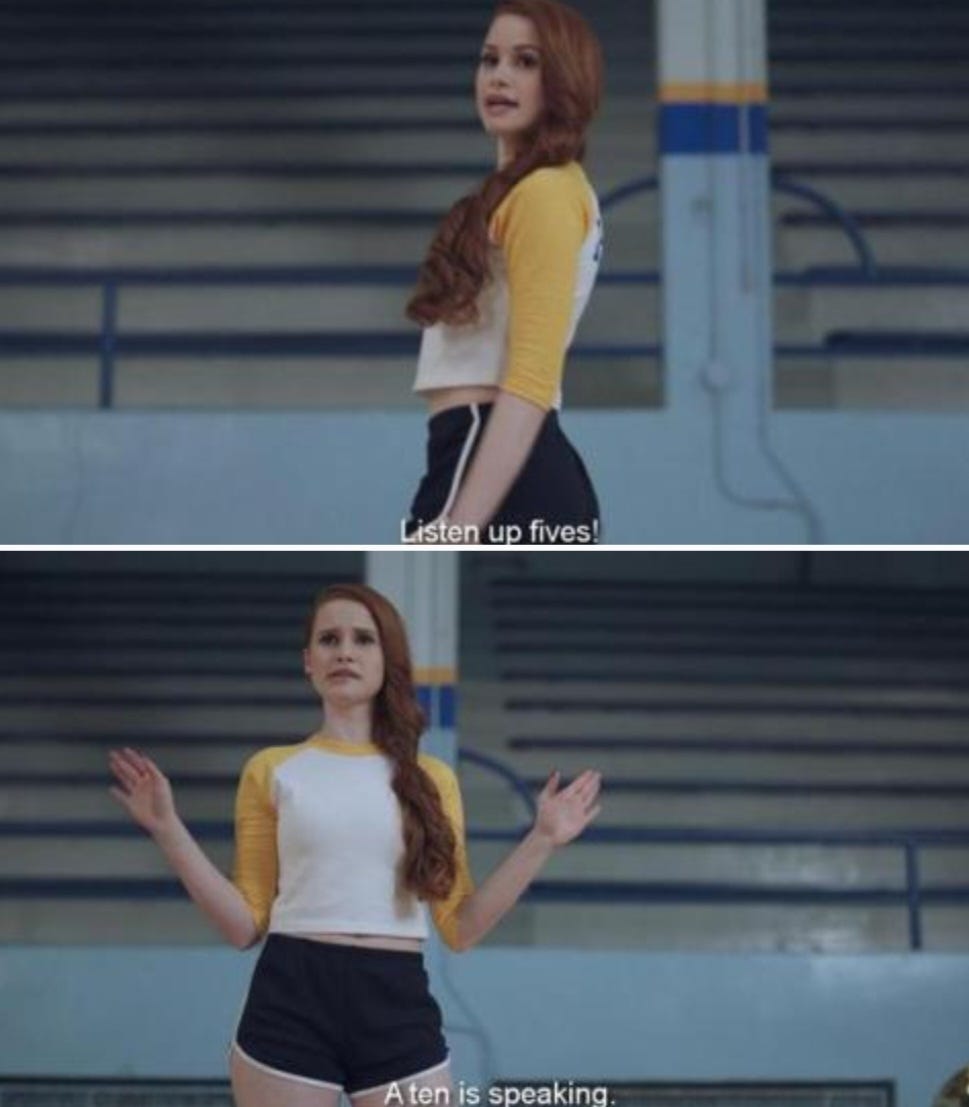
Like, I’m not saying that the writer of the listicle saw this specific edit and assumed it was real, but I am saying that no-one does any goddamn research, they just regurgitate whatever they hear through the grapevine. It’s too normie, it’s too weird, cringe bad cringe bad.
Which is to say that you can’t trust anything you read about Riverdale without watching the show. Both the fans and the critics really like describing the plot of the show out of context to emphasise the wacky elements. Even in that bit I did earlier, I said that Jughead skinned a woman, but I didn’t explain why. Mostly because I don’t remember why, but also because “Jughead skinned a woman” is a funny sentence to say to people who haven’t watched Riverdale since season 1. I have this in common with people who hate the show, but the difference is that I think a show where progressively more absurd things keep happening and all of the characters are insane is fun, and the critics would prefer a story where the chain of consequence is more believable and the characters act like real people, or at least the way they’re used to seeing characters act.
And that’s what I really don’t get. As pop culture becomes more formulaic, why shun the bizarre? Frankly, I think the Riverdale writers should do drugs at least once; maybe then they’d stop writing War On Drugs propaganda and start letting Veronica and Reggie do jingle jangle in their cabaret crime casino. And to those who feel the need to point out that these shenanigans are unrealistic… I’d say if you want realism watch the news, but the news is propaganda. Truth is dead, we have killed it, and this blood on our hands is an iconic fashion moment.
In conclusion, forget it Jughead it’s Riverdale.